
Maximizing Yield with High-Density Trellises: The Need for Specialized Orchard and Vineyard Spreaders
Are you looking to transform your orchard or vineyard, packing more productive trees or vines into every acre? High-density trellis systems are rapidly gaining traction among forward-thinking growers, offering a powerful way to boost yields and maximize limited land. By using trellises to support closer plantings, these innovative systems are reshaping how growers approach efficiency, fruit quality, and profitability.
Unlike traditional setups with widely spaced rows, high-density orchards and vineyards feature much narrower spacing—often 8 to 14 feet between rows for apples or 6 to 10 feet for grapes. This strategic approach leads to significantly higher production, quicker returns on investment, superior fruit quality, and the need for a new kind of vineyard spreader. This shift isn’t just a passing trend; it’s a calculated move toward a more productive and sustainable future.
What Is a High-Density Trellis System?
High-density trellis systems revolutionize traditional orchard and vineyard layouts by bringing plants significantly closer together with supportive frameworks. In apple orchards, trees are typically spaced just 3-6 feet apart within rows and 8-14 feet between rows, enabling 800-2,000+ trees per acre. This is a dramatic increase from the 150-180 trees in conventional setups.
Vineyards follow similar principles, with vines placed 3-6 feet apart in rows spaced only 6-10 feet from each other, customized based on site conditions and vine vigor. These compact arrangements rely on specialized elements working in harmony: dwarfing rootstocks that control plant size while maintaining productivity, specialized training systems like Tall Spindle for apples or Vertical Shoot Positioning (VSP) for grapes, and robust support structures designed to bear heavy fruit loads.
High-density systems excel with crops that respond well to intensive management, including apples, pears, and cherries in orchards, and nearly all wine and table grape varieties in vineyards. By carefully controlling both vertical and horizontal growth, these sophisticated systems transform traditionally sprawling plants into productive, space-efficient powerhouses.
What Are the Benefits of High-Density Trellis Systems?
The advantages of adopting high-density systems are compelling and multifaceted. More plants per acre naturally translate to more fruit, with high-density apple orchards yielding up to double the harvest of traditional setups. This increased productivity provides growers with a significantly faster return on their investment.
These systems also mature remarkably quickly. Apple trees can begin significant production within just 2-3 years and reach their full potential by years 5-7, far outpacing the 10-15 years typical for traditional orchards. This accelerated timeline means you’ll see profits sooner while staying competitive in rapidly evolving markets.
Narrow rows and trellised canopies optimize sunlight exposure and air circulation throughout the plant, leading to more uniform ripening, potentially higher Brix levels, better color development, and consistently sized fruit. These improvements result in higher-quality harvests that command premium prices and buyer attention.
The compact and organized layout simplifies critical tasks like pruning, thinning, and harvesting, many of which can be performed from ground level. This efficiency not only reduces labor time but also enhances worker safety and satisfaction. Furthermore, these systems are naturally more conducive to mechanization, a significant advantage in today’s challenging labor market.
Well-managed canopies in tight spacing, coupled with improved air movement and easier access for targeted spraying, contribute to more effective pest and disease management. This integrated approach helps keep crops healthier with potentially reduced chemical inputs, benefiting both your bottom line and the environment.
Key Components of a High-Density Trellis System
Successfully implementing a high-density system comes down to getting a few key components right. Strong support structures are essential, whether that means a simple single-wire setup or more complex V-trellis and T-trellis designs. Durable posts and tightly tensioned wires help carry heavy fruit loads while holding up against wind and snow.
Because these systems are more intensive, precision water and nutrient delivery also becomes critical. Drip irrigation and fertigation help ensure plants get what they need at the right time, while consistent training and pruning keep growth controlled and fruit quality high. Just as important is soil and nutrient management, supported by regular soil testing and accurate applications of lime and fertilizer. That is where the right equipment, like a reliable orchard spreader or vineyard spreader, becomes a major advantage in tight orchard and vineyard rows.
What Are Some Challenges and Considerations?
Despite the numerous benefits, high-density systems present certain challenges that require careful planning. The initial investment can be substantial, potentially $10,000 per acre or more when factoring in trellises, irrigation systems, and the higher number of plants required. This upfront cost must be carefully weighed against the accelerated returns these systems can provide.
These intensive systems demand a higher level of management skill and attention to detail, with more frequent and precise pruning, irrigation, and feeding schedules. Growers must be prepared to adopt new techniques and potentially invest in additional training for themselves and their staff.
The potential for significantly larger crops means growers must also carefully consider market capacity and sales channels to avoid issues with oversupply potentially depressing prices. Advance planning for marketing and distribution becomes increasingly important as these systems deliver higher productivity.
Perhaps the most significant hurdle is the equipment challenge. Narrow rows, often just 8 to 14 feet in orchards or 6 to 10 feet in vineyards, make it difficult to find machinery that fits without damaging trees, vines, or trellis structures. Traditional spreaders, designed for wider row crops, are often too bulky and risk clipping valuable plants, compacting soil too close to delicate root systems, or failing to deliver materials accurately to the targeted root zone.
Operating an unsuitable orchard spreader or vineyard spreader can quickly negate efficiency gains and lead to costly crop damage. Specialized, narrow-profile equipment is not just a luxury but a necessity to keep these advanced systems running smoothly and profitably.
How Stoltzfus Spreaders Supports High-Density Orchards and Vineyards
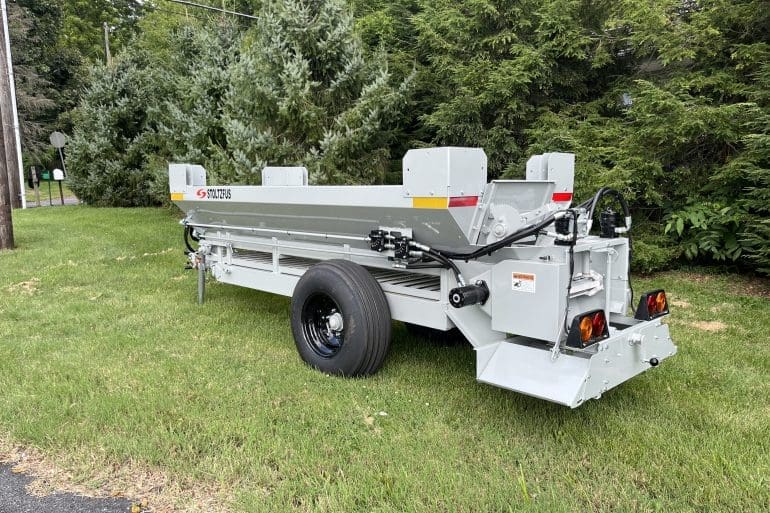
That’s where Stoltzfus Spreaders makes a critical difference. We understand the unique demands of modern high-density agriculture and have developed solutions specifically for these challenging environments. Our new Narrow Profile Banding Spreader (NPB-175) is engineered from the ground up as a high-performance orchard spreader and vineyard spreader for these tight spaces.
With a width of just 52 inches, even when its banders are fully extended, the NPB-175 slips easily down narrow rows where standard equipment cannot operate. Its innovative design ensures precise, targeted application of compost, lime, gypsum, and fertilizer exactly where your high-density plantings need it, along the tree or vine rows, minimizing waste and maximizing nutrient uptake.
This specialized orchard spreader features a robust drag chain system to prevent material bridging and ensure consistent flow, tackling one of the biggest headaches of high-density growing: finding equipment that fits and performs. Our spreaders help you maintain peak soil health and plant productivity without compromising your valuable crop or meticulously planned growing system.
Vineyard Spreaders: Essential Equipment for High-Density Trellis Systems
High-density trellis systems are paving the way for a more productive, efficient, and sustainable future in fruit and grape cultivation. Offering higher yields, superior fruit quality, and streamlined management, they represent a smart investment for growers ready to embrace innovation—despite the initial costs, intensive oversight, and the critical need for correctly sized equipment.
As narrow-row planting becomes increasingly prevalent across the industry, having the right tools, like a dedicated vineyard spreader or orchard spreader, is essential to thrive in this competitive landscape. If you are looking to boost profitability and make every acre count, high-density systems could be your path forward. And if you are adopting or optimizing such a system, ensure your equipment can meet the unique challenges these advanced growing methods present.
Ready to equip your high-density operation for success? Discover how the Stoltzfus NPB-175 Narrow Profile Banding Spreader can solve your narrow-row spreading needs. Contact us today for a personalized consultation!