
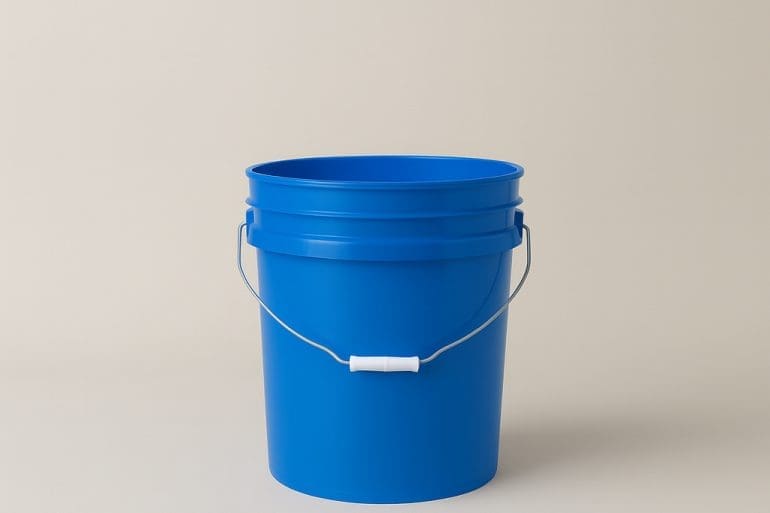
Using a Five-Gallon Bucket to Measure Material Density
Knowing how heavy your lime, fertilizer, gypsum, or compost is per cubic foot makes it much easier to set a spreader correctly. You do not need special lab equipment to find this. You can do it in the shop with a 5-gallon bucket and a scale.
In short: fill a 5-gallon bucket with your material, subtract the weight of the empty bucket, then divide by 0.67 to get pounds per cubic foot.
A standard 5-gallon bucket holds about 0.67 cubic feet of material.
Whether for your wet lime spreader, litter spreader, compost spreader, or gypsum spreader, knowing the material density will greatly improve your efficiency.
Simple Step-by-Step Instructions
What you need
- One standard 5-gallon plastic bucket
- A scale that can read in pounds
(a bathroom scale, platform scale, or hanging scale will all work) - The material you plan to spread (lime, fertilizer, and so on)
Step 1: Weigh the empty bucket
- Put the empty bucket on the scale.
- Write down the weight.
- Example: Empty bucket = 2.5 lb
This is your bucket weight.
Step 2: Fill the bucket with material
- Fill the bucket with the material you want to test.
- Fill it to your 5-gallon mark (see Best Practices below), or level to the top if you have not marked it yet.
- Do not pound or pack the material down. Let it settle naturally.
Step 3: Weigh the full bucket
- Put the full bucket on the scale.
- Write down the weight.
- Example: Full bucket = 37.5 lb
This is your full bucket weight.
Step 4: Find the weight of the material in the bucket
Subtract the empty bucket weight from the full bucket weight:
Material weight in bucket = Full bucket weight − Empty bucket weight
Using the example:
- Full bucket: 37.5 lb
- Empty bucket: 2.5 lb
37.5 − 2.5 = 35 lb of material in the bucket
Step 5: Convert to pounds per cubic foot
A 5-gallon bucket is about 0.67 cubic feet.
To find pounds per cubic foot, divide by 0.67:
Pounds per cubic foot = (material weight in bucket) ÷ 0.67
Using the example:
- Material weight in bucket = 35 lb
- 35 ÷ 0.67 ≈ 52 lb per cubic foot
If you do not want to divide, you can use this shortcut:
Pounds per cubic foot ≈ (material weight in bucket) × 1.5
Example:
- 35 lb × 1.5 ≈ 52.5 lb per cubic foot, which is close enough for field work
This pounds per cubic foot number is the density of your material. You or your dealer can use that number when setting up your spreader.
Best Practices for Accurate Results
Once you understand the basic method, these tips will help you get better numbers.
1. Mark the true 5-gallon line on your bucket
Not every “5-gallon” bucket is exactly 5 gallons, and most people do not fill right to the rim in real life. It is more accurate to mark a 5-gallon line inside the bucket and use that line every time.
To mark the line:
- Put the empty bucket on level ground.
- Measure out exactly 5 gallons of water:
- Use a 5-gallon jug, or
- Fill and pour five 1-gallon jugs into the bucket
- Once the water is in the bucket, look at the water level inside the bucket.
- Use a permanent marker or a narrow strip of tape to mark that water level on the inside of the bucket.
- Empty and dry the bucket.
From now on, when you test material:
- Fill the bucket to that line, not to the very top.
- Weigh the bucket the same way as before (empty and then full) and do the same math.
This gives you a known 5-gallon volume every time, which makes your density numbers more accurate and easier to repeat.
2. Use the same bucket every time
- Stick with one standard 5-gallon bucket for all your tests.
- Write the empty bucket weight on the side with a marker so you do not have to re-weigh it.
3. Do not pack the material
- Pour the material in and let it settle on its own.
- Do not stomp, shake hard, or pound the bucket.
- Packing can make the material seem heavier than it will be in the spreader.
4. Take more than one sample
- Material can vary across different parts of the pile.
- Fill and weigh the bucket 2 or 3 times from different spots, then average the results:
- Add the pounds per cubic foot from each test.
- Divide by the number of tests.
This gives a better picture of the whole load.
5. Test material as close to spreading time as possible
- Moisture changes density. Wet lime or fertilizer will be much heavier than dry.
- If rain or dew hits the pile, re-check the density before spreading.
6. Keep notes
Write down:
- Date
- Material type and source (for example, “Hi-cal lime from XYZ Quarry”)
- Moisture condition (dry, damp, very wet)
- Pounds per cubic foot
Over time you will build your own chart of density numbers for the materials you commonly use.
7. Use the right scale
- Make sure your scale can handle the weight of a full bucket plus material.
- If using a bathroom scale and the bucket is awkward:
- Step on the scale holding the bucket, and note the weight.
- Step on the scale without the bucket, and note the weight.
- Subtract to get the bucket weight.
Why This Matters
Spreaders often need to be calibrated based on how heavy the material is, not just how much space it takes up. Two piles that look the same size can have very different weights if the moisture or material type is different.
By taking a few minutes with a 5-gallon bucket and a scale, you can:
- Get a real density number for the actual material in your yard today.
- Help set your lime spreader more accurately.
- Avoid overapplying or underapplying product, which saves money and protects your fields.