
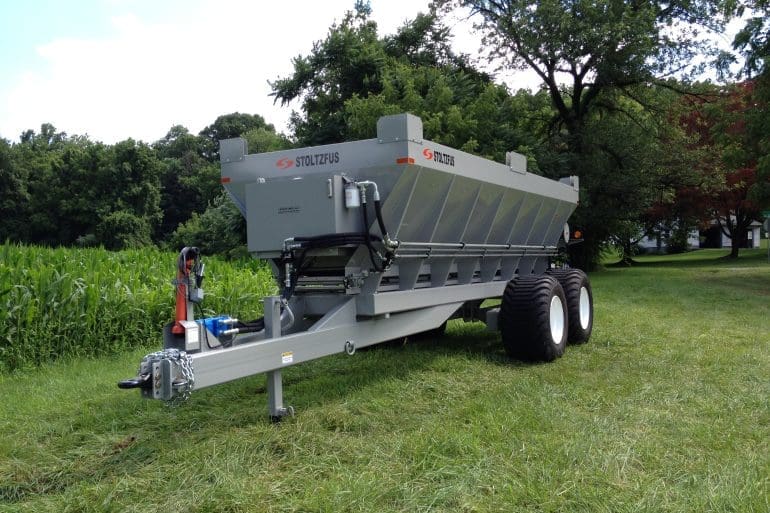
Boost Soil Health and Yields with a Compost Broadcast Spreader
For corn and soybean growers, the health of their soil is one of the most important factors influencing long-term productivity and profitability. While synthetic fertilizers play a key role in nutrient delivery, they don’t always address the underlying biological and structural issues that limit yields over time. That’s where compost comes in – and with the right equipment, applying it efficiently across large acreages is both practical and profitable.
The Stoltzfus Bulk Material Spreader is purpose-built to serve as a high-capacity, reliable compost broadcast spreader. For row crop farmers seeking to improve soil health and raise yields, this machine provides a smart way to apply compost evenly and effectively at scale.
The Link Between Soil Health and Crop Yields
Soil isn’t just a medium to anchor roots – it’s a living system. In healthy soils, microorganisms break down organic matter, cycle nutrients, and improve soil structure. This biological activity increases water infiltration and retention, reduces compaction, and ultimately makes more nutrients available to plants when they need them.
Compost is one of the most effective tools available to improve soil health. Unlike synthetic fertilizers, compost adds organic matter, feeds soil microbes, and helps balance soil pH. Over time, these benefits translate into better root development, more resilient crops, and increased yields for corn and soybeans.
What Is a Compost Broadcast Spreader?
A compost broadcast spreader is a type of agricultural implement designed to distribute compost evenly across fields. For large-scale farms, the key requirement is consistent, high-capacity performance. That’s where the Stoltzfus Bulk Material Spreader excels.
Designed with farmers in mind, this compost spreader handles a variety of bulk materials, including compost, poultry litter, and lime. Its strength lies in managing heavier organic materials like compost without clogging or uneven flow. Spreading compost in a uniform pattern ensures every part of the field benefits equally from the application.
Key Benefits of Using a Compost Spreader
When it comes to improving soil health and maximizing efficiency in the field, the right compost broadcast spreader makes all the difference. Farmers using the Stoltzfus bulk material spreader benefit from superior engineering, precise application, and rugged durability designed for heavy-duty agricultural use.
1. Even Application, Better Results
Broadcasting compost with a dedicated spreader ensures that the material is evenly distributed across the field. Uneven application can lead to nutrient imbalances, patchy growth, and wasted inputs. A compost spreader solves this by delivering a consistent spread pattern that maximizes the value of each ton of compost applied.
2. Time and Labor Savings
Compost is bulky, and spreading it manually or with underpowered equipment can become a bottleneck during busy fieldwork seasons. A Stoltzfus compost broadcast spreader is designed for high-throughput operation, allowing farmers to cover more acres in less time with fewer labor hours.
3. Soil Health Improvements That Stick
Compost adds stable organic matter to soil, which improves tilth and encourages beneficial microbial life. This leads to more resilient soils that can withstand drought, heavy rain, and other stressors more effectively. Improved soil structure also reduces erosion and compaction—critical issues in high-traffic row crop systems.
4. Flexibility with Materials
While compost is the focus, it’s worth noting that a spreader like the Stoltzfus Bulk Material Spreader can handle other materials like poultry litter and lime. This makes it a versatile tool that can be used across different seasons and fertility strategies.
How Compost Boosts Yields
The biological activity stimulated by compost unlocks a cascade of benefits. As microbes decompose organic matter, they release nutrients in a form that’s more readily taken up by plants. Compost also improves cation exchange capacity (CEC), which enhances the soil’s ability to hold nutrients in place and deliver them to crops gradually throughout the growing season.
In corn and soybean systems, the effect of compost may not be instant, but it builds year over year. Many farmers report improved early-season vigor, more uniform stands, and better drought resistance after incorporating compost into their nutrient program.
When to Use a Compost Broadcast Spreader
Timing and technique can make a major difference in the effectiveness of compost applications. A compost broadcast spreader like the Stoltzfus model helps ensure even distribution, but knowing when and how to use it can further enhance results.
For most corn and soybean operations, compost is best applied in early spring before planting or after harvest in the fall, when the soil surface is accessible and fieldwork can be done efficiently. Applying compost ahead of planting allows beneficial microbes to activate and begin breaking down organic matter, enriching the soil structure in time for seed germination.
A bulk material spreader equipped with a spinner spreader system ensures that compost particles are spread evenly, minimizing the need for additional passes and preventing nutrient hot spots. Operators should calibrate the spreader based on compost moisture and density to ensure uniform coverage and prevent waste.
Because compost continues to release nutrients throughout the season, farmers often notice gradual but lasting yield improvements. Consistent application with a quality compost broadcast spreader can also reduce dependency on synthetic fertilizers, helping lower input costs while improving soil health over time.
The Stoltzfus Bulk Material Spreader: Built for the Job
A Stoltzfus compost broadcast spreader stands out in its class for several key reasons. It features heavy-duty construction to handle difficult materials like compost, with corrosion-resistant components and high-torque hydraulic spinners that deliver a wide, even spread pattern.
Models are available with capacities ranging from 2 to 20 tons, making them suitable for both medium and large-scale operations. The compost spreader is designed with wide flotation tires to reduce soil compaction. It includes options for scale systems and variable rate controllers, making it ideal for farmers looking to integrate compost spreading into a precision agriculture program.
Unlike many mass-produced machines, Stoltzfus offers custom configurations tailored to each operation’s needs. That means if a farm requires a specific wheel spacing, hopper capacity, or driveline setup, it can be built into the machine from the start.
Compost Application in Practice
Compost doesn’t replace traditional fertilizers entirely, but it complements them by improving nutrient use efficiency and reducing reliance on synthetic inputs over time.
On row crop farms, compost is typically applied before planting in the spring or after harvest in the fall. The key is to apply it evenly and give it time to integrate into the soil profile before seeding or emergence. With the Stoltzfus compost spreader, one pass covers a wide area, and the material is distributed in a pattern that supports uniform crop growth across the field.
Final Thoughts
Healthy soils grow better crops. For corn and soybean farmers looking to build long-term productivity, compost is a smart investment—and the right compost broadcast spreader makes it practical on a large scale.
The Stoltzfus Bulk Material Spreader offers the strength, capacity, and precision needed to apply compost efficiently and evenly across hundreds or thousands of acres. With durable construction and custom-built options, it’s a tool that delivers season after season.
To learn more about how Stoltzfus compost broadcast spreaders can fit into your nutrient management program, visit stoltzfusspreaders.com or contact us to discuss your specific needs.